OpenAI AgentKit: The New Era of Agent-First Development
Breaking down OpenAI's AgentKit toolkit, why it matters, and how it stacks up against n8n and Flowise.
🧠 OpenAI AgentKit: The New Era of Agent-First Development
In October 2025, OpenAI quietly launched something that could redefine how developers build agentic systems: AgentKit. It is not another API wrapper or prompt playground — it is a complete toolkit for designing, deploying, and monitoring intelligent agents that can reason, use tools, and integrate with real-world data.
But what exactly is AgentKit? And how does it compare with other workflow automation or agent-building tools like n8n and Flowise?
Let’s break it down.
🚀 What Is OpenAI AgentKit?
AgentKit is a suite of developer tools that simplifies every stage of building AI agents — from visual workflow design to safety and evaluation.
It includes several core components:
| Component | Function |
|---|---|
| Agent Builder | A visual editor to design multi-step agent workflows and hand-offs between subagents. |
| ChatKit | An embeddable chat UI toolkit for your app, with streaming responses, theming, and session management. |
| Connector Registry | Secure integrations to services like Google Drive, Dropbox, Microsoft Teams, and more. |
| Guardrails | Policy enforcement, PII masking, and safe-execution controls. |
| Evals & Tracing | Tools to evaluate reasoning accuracy, trace agent runs, and visualize logic. |
| Agents SDK | A programmatic way to build or extend agents with Python or TypeScript. |
In short: AgentKit provides the “agent brain and nervous system.” You still bring your frontend, backend, and data — but AgentKit takes care of the orchestration, safety, and evaluation.
⚙️ Why AgentKit Matters
Traditional AI apps often stop at “prompt → response.” AgentKit shifts the model to “goal → reasoning → action → verification.”
It is designed to:
- Bridge the gap between prototyping and production.
- Make agents observable and auditable.
- Provide policy-grade safety for enterprise contexts.
- Simplify embedding conversational agents into products.
If ChatGPT was a single powerful assistant, AgentKit is the framework to build many assistants — each with defined roles, responsibilities, and connectors.
⚖️ How It Compares: AgentKit vs n8n vs Flowise
When you zoom out, AgentKit competes not only with agent frameworks like LangChain or AutoGen, but also with workflow tools like n8n and Flowise — both popular in automation and open-source AI communities.
Let’s compare them through six critical lenses, keeping the scorecard, visual snapshot, and proof points together for an easy read.
Scorecard at a Glance
| Criteria | OpenAI AgentKit | n8n | Flowise |
|---|---|---|---|
| Ease of Use | Intuitive visual builder, minimal code for chat apps | Simple node editor but more generic | Drag-and-drop with instant feedback |
| Customization | Moderate (extend with SDK) | Very high via custom code nodes | Extremely high (open source, editable) |
| Safety & Guardrails | Enterprise-grade policy & eval tools | Manual error handling, no AI guardrails | Basic validation, depends on community |
| Integration Ecosystem | Connector registry (growing) | 400+ integrations built-in | Flexible but fewer official connectors |
| Deployment Control | Fully hosted by OpenAI | Fully self-hostable | Fully self-hostable |
| Agentic Specialization | Deep multi-agent orchestration, evals, tracing | Limited (automation focus) | Strong (multi-agent graphs, RAG, memory) |
Visual Comparison
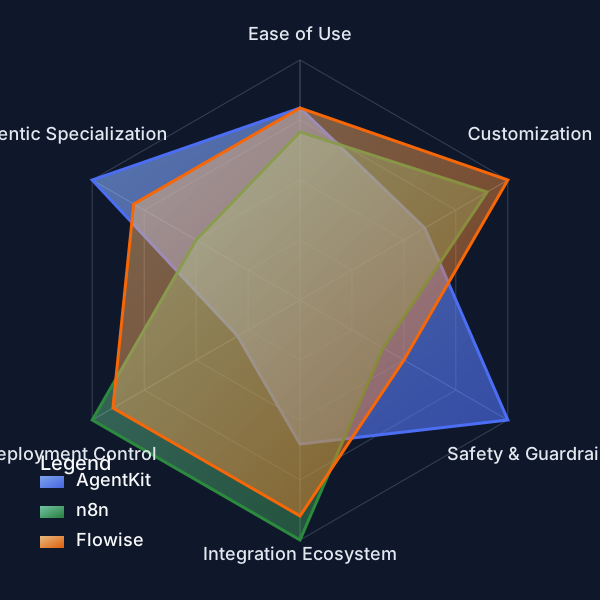
Here is a radar chart summarizing the relative strengths of each platform:
Interpretation:
- 🟦 AgentKit — optimized for safe, agentic reasoning and production deployment.
- 🟩 n8n — strongest in connectivity and workflow automation.
- 🟧 Flowise — excels in customization and self-hosting flexibility.
(The chart shows subjective normalized scores across 1–10 for each category.)
Proof Points Behind the Scores
Below is the reasoning — the “why” behind each score.
| # | Criterion | Evidence & Analytics |
|---|---|---|
| 1 | Ease of Use | AgentKit (8/10): Includes Agent Builder and ChatKit for low-code workflows and chat embedding. However, backend customization is limited. n8n (7/10): Easy node UI but requires more setup for AI tasks. Flowise (8/10): Fast to prototype, visual graph, good defaults; slightly rougher UX. |
| 2 | Customization | AgentKit (6/10): Extendable via SDK but constrained by hosted nature and fixed connectors. n8n (9/10): Add JS code, HTTP calls, or custom nodes freely. Flowise (10/10): Fully open-source, custom nodes, and editable logic. |
| 3 | Safety & Guardrails | AgentKit (10/10): Native guardrails for PII masking, content filtering, compliance, and audit traces. n8n (4/10): Generic error handling only. Flowise (5/10): Safety depends on custom LangChain filters; no built-in guardrail system. |
| 4 | Integration Ecosystem | AgentKit (6/10): Early-stage connector registry (Google Drive, Teams). n8n (10/10): 400+ official integrations, broadest coverage. Flowise (9/10): Supports vector stores, RAGs, APIs; slightly less enterprise-grade breadth. |
| 5 | Deployment Control | AgentKit (3/10): Managed by OpenAI; no self-hosting. n8n (10/10): Fully self-hostable, local or cloud. Flowise (9/10): Fully open-source, self-hostable, but less documented for scaling. |
| 6 | Agentic Specialization | AgentKit (10/10): Purpose-built for agents — multi-agent orchestration, evals, tracing, handoffs. n8n (5/10): AI support generic; lacks reasoning primitives. Flowise (8/10): LangChain-based multi-agent and RAG graphs, strong but less governed. |
🧭 When to Use Each Platform
✅ Choose AgentKit if…
- You are building conversational or reasoning-based agents.
- You want evaluation, guardrails, and observability built-in.
- You plan to embed the agent directly in your app via ChatKit.
- You value managed hosting and model optimization over infrastructure control.
✅ Choose n8n if…
- Your goal is business process automation or API orchestration.
- You want to connect hundreds of systems (CRM, analytics, email, etc.).
- You prefer a self-hosted, no-lock-in automation stack.
✅ Choose Flowise if…
- You love open source and want to tinker or extend agent logic deeply.
- You need RAG pipelines, multi-agent graphs, or custom integrations.
- You prefer full control over deployment and security.
🧩 The Bigger Picture: Agent-First Ecosystems
OpenAI’s AgentKit signals a shift toward “agent-as-a-platform” thinking:
A future where each product, not just each user, runs its own specialized agents.
While Flowise and n8n empower open or hybrid approaches, AgentKit leans toward enterprise reliability, safety, and evaluation depth — the kind of features organizations will need when AI agents move from experimental chatbots to mission-critical operators.
🧠 Final Thoughts
AgentKit is not trying to replace your backend or automation tools — it is a purpose-built agent framework designed for safety, reasoning, and scalable deployment.
If you are building:
- a chat-based assistant for your app,
- a multi-agent workflow for support or sales, or
- an evaluated reasoning system that must comply with policies,
then AgentKit gives you the shortest, safest path to production.
If you found this useful, feel free to connect on LinkedIn or check out my projects on GitHub.